

It’s not uncommon for businesses to struggle with leadership disconnect – whether that’s a siloed problem amongst specific teams, a communication problem across certain parts of the organization or a larger culture issue that’s company-wide.
That last example is when red flags start flying, and right now, workplaces are at full mast. Insperity Northstar Network’s recent report reveals a major gap in perceptions of middle manager performance across organizational levels.
In this discussion, we’ll cover:
- What is the manager performance gap?
- Where does the manager performance gap show up most?
- What’s at stake: Why closing the manager perception gap is critical
- Why this is a strategy – not talent – problem
- How to align manager performance with employee expectations and close the manager perception gap
- Frequently asked questions
- Summary
What is the manager performance gap?
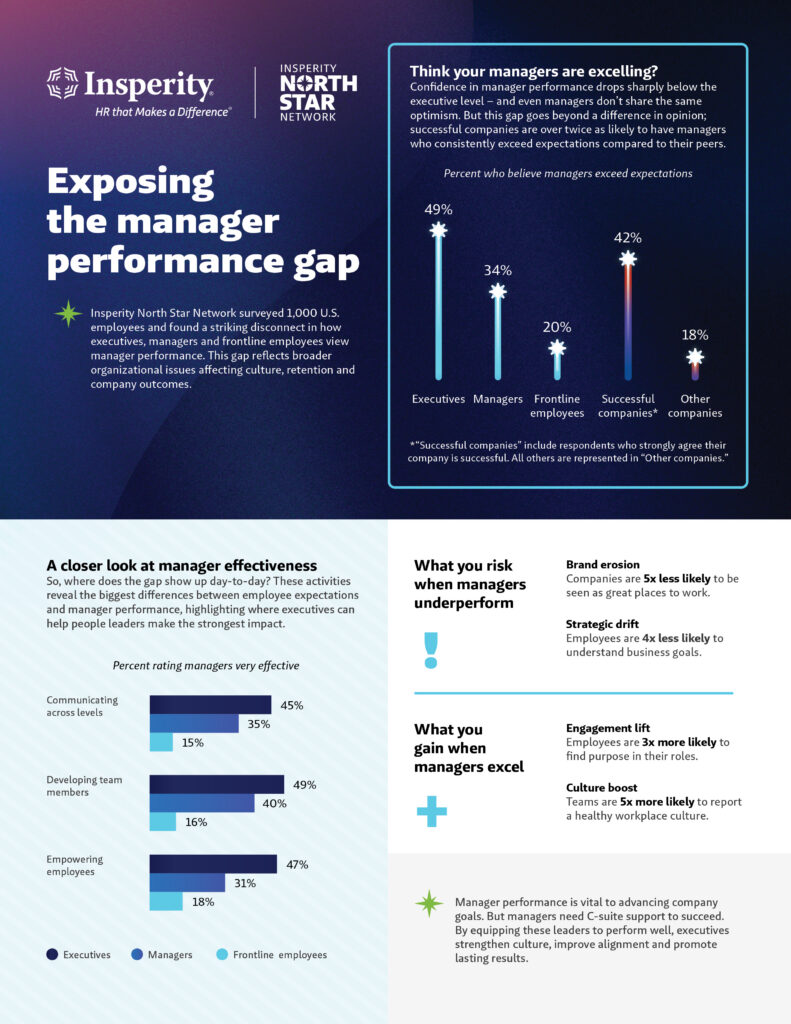
According to the research, Cracking the code on manager impact, the survey revealed that nearly half – 49% – of executives say their managers exceed expectations. Yet only 20% of frontline employees agree.
Even middle managers don’t rate themselves as highly as executives, with only 34% of managers assessing themselves as exceeding expectations.
Senior executives may think everything is going great. But frontline employees tell a quite different – and less optimistic – story. This isn’t just a small gap – it’s more like a yawning chasm. And it isn’t a mere difference of perspective – it’s a glaring warning sign that your business may face deeper organizational issues. Take a look at the numbers:
When present, this manager perception gap may be quietly eroding your workplace culture while chipping away at employee engagement and productivity and, ultimately, diminishing bottom-line results. This is because managers are central to the employee experience and day-to-day operations.
Conversely, closing the manager perception gap improves leadership alignment along with business performance.

Where does the manager performance gap show up most?
The biggest gaps in perception of manager performance between executives, managers and frontline employees show up in five key areas:
- Communication across organizational levels
- Training and development of team members
- Empowering employees by removing obstacles
- Recognition and reward
- Promoting good company culture
These are the five activities that survey respondents said drive significant business impact the most, listed in order of where the gap between employee expectations and manager performance is the greatest.
What’s at stake: Why closing the manager perception gap is critical
When managers don’t meet the expectations of frontline employees or lead them effectively, there can be direct, negative consequences to your business. But when managers do meet expectations and succeed, the impact reverberates in a positive way across your business.
After all, according to Gallup’s outgoing meta-analysis, managers account for 70% of the variance in employee engagement. This means they have an outsized impact on your employee experience.
When managers underperform:
- Companies are five times less likely to be seen as a great place to work – not exactly a competitive edge in the talent war.
- Employees are four times less likely to understand their business’ vision and goals, which can impair their performance and put them out of alignment with business strategy.
- Burnout rates soar to 83% of employees.
When managers excel:
- Employees are three times more likely to be engaged and find purpose and meaning in their roles, driving better customer service, more innovation and greater discretionary effort.
- Teams are five times more likely to report a healthy workplace culture.
- Employee burnout rates drop by 36%, which boosts morale and retention.
Clearly, there’s a lot of room for growth and improvement when the leadership disconnect disappears and manager performance meets employee expectations.
Why this is a strategy – not talent – problem
Most likely, it’s not that you promoted the wrong people or the managers you hired are poor performers. Instead, they’re susceptible to the same challenges that frontline employees encounter – but all too often, no one’s looking out for or taking care of middle managers.
Frequent obstacles that managers face include:
- Overwhelming workloads
- Too many administrative burdens
- Competing priorities
- Insufficient preparation for managing people
These roadblocks often prevent them from prioritizing higher-value leadership activities.
Even the most capable talent could struggle to deliver results in this type of environment.
As it turns out, your manager perception gap probably isn’t a talent issue – it’s an organizational strategy, structure and systems issue. Even the most skilled managers can’t thrive and serve their team members well without the right support in place.
How to align manager performance with employee expectations and close the manager perception gap
1. Promote more effective communication
The data from the report shows that only 15% of frontline employees consider their managers effective at communicating across organizational levels.
Your managers must become more adept at serving as a communication bridge between senior leaders and frontline employees. They must practice active listening with their team members, gathering their input and funneling it upward to senior management.
Then they must practice transparency and communicate back downward to their team members, sharing the rationale behind company decisions and explaining how employee feedback has been acted upon.
How senior leaders can support managers:
- Help managers understand the right questions to ask employees to obtain valuable insights.
- Formalize feedback channels, creating structured ways for managers to share key intel and raise concerns with executives.
- Provide tools to help managers across organizational levels like standardized email templates.
- Explain to managers how to tie business decisions and organizational changes to strategy.
2. Better train and equip managers
Only 51% of newer managers – those with less than three years of leadership experience – feel prepared to manage people. This lack of preparedness is why 74% of newer managers report high levels of burnout that is reflected in their performance.
Today’s employees want a human leader – someone to coach their performance, guide their careers, oversee their development and empower them to take risks and succeed. This is a complex role, requiring many skill sets.
How senior leaders can improve manager readiness:
- Deploy a leadership development strategy.
- Establish a high-potential leadership program that proactively identifies future managers and begins training them on valuable skills well before they ever step into their new role.
- Offer a formal leadership training program for new managers, such as workshops, online courses and certifications.
- Require all managers to engage in personalized, ongoing learning and development that prioritizes real-world scenarios; cultivates relevant, in-demand skills; and asks them to solve challenges in real time.
- Clearly set expectations for their performance and define goals.
- Provide executive coaching and peer mentoring to managers.
3. Redefine success metrics
To determine manager effectiveness, don’t just rely on their output. Effective management isn’t just about the numbers at the end of a project; it’s how well your people are led during the project. Success starts with:
- Mangers acting as a coach and facilitator of success: This looks like meaningful conversations, involving employees in their own performance goals, and setting expectations.
- Delivering a consistent culture: A stable organizational culture can be the difference between a workplace that’s good and one that’s exceptional. And managers are at the top of the list when it comes to regular, consistent opportunity to embody and showcase the organizational culture to their employees.
- Balancing flow and burnout: Leaders have to build resiliency and engagement, which happens by playing an important role in how employees respond to challenges.
4. Provide feedback
It’s a big part of any manager’s job to evaluate the performance of their team members – but too often, no one is evaluating the managers themselves. Executives must overcome their own lack of visibility into managers’ performance and deliver regular feedback.
This not only boosts managers’ confidence but also helps them identify areas for improvement.
How senior leaders can support managers:
- Design systems for providing regular manager feedback.
- Incorporate input from frontline employees into performance evaluations.
Frequently asked questions
- What are the red flags that my business may have a manager perception gap?
Warning signs include low employee engagement, high burnout rates and poor alignment with company vision. If frontline employees report communication issues, lack of recognition or insufficient development opportunities, these are strong indicators of a perception gap.
- What challenges do my managers face in their day-to-day work?
Common challenges include overwhelming workloads, administrative burdens, competing priorities and insufficient preparation for managing people. These obstacles often prevent managers from focusing on high-value leadership activities like coaching and communication.
- What steps can I take today to better support my managers
Start by improving communication channels, offering leadership development programs, redefining success metrics beyond output and providing regular feedback. Formalize feedback loops, equip managers with tools and ensure they understand how to connect decisions to strategy.
Summary
- A manager performance gap occurs when there is a significant disparity between how executives and frontline employees view middle manager performance.
- Manager performance gaps are often a quiet risk that can do great harm to your employees and business as a whole.
- A manager perception gap isn’t inevitable, but it does highlight deeper systemic problems and signals that work to realign manager performance with employee expectations is overdue.
- Closing the manager performance gap improves employee engagement, productivity and retention, and promotes business success.
To read more about this leadership disconnect, download the Insperity North Star Network report: Cracking the code on manager impact: closing the gap between perception and performance.