


Business leaders rarely set out to become HR administrators. Yet for many growing organizations, leaders find themselves handling payroll questions, tracking compliance requirements, managing benefits issues and navigating employee challenges alongside their core responsibilities.
While these tasks are important, they can come at a cost: time and attention that could otherwise be spent leading the business.
A new research report, Reclaim your leadership with expert HR support, from Insperity and Lighthouse Research & Advisory suggests that HR administration isn’t just an HR challenge. It’s a leadership challenge. As administrative responsibilities grow, many leaders find themselves with less time for strategic thinking, business development and the activities that drive long-term success.
Table of contents
- Leadership requires time to lead
- The challenge often intensifies as organizations grow
- Administrative work doesn’t stay within business hours
- The opportunity cost of administrative leadership
- What leaders do with time they get back
- Leadership is too important to be an afterthought
- Key takeaways
- Frequently asked questions about HR administration and leadership
Leadership requires time to lead
Effective leadership goes beyond managing day-to-day operations. Leaders are responsible for setting direction, identifying opportunities, solving complex problems and helping their organizations prepare for the future.
But many business leaders are balancing those responsibilities with a growing list of HR-related tasks.
According to the research:
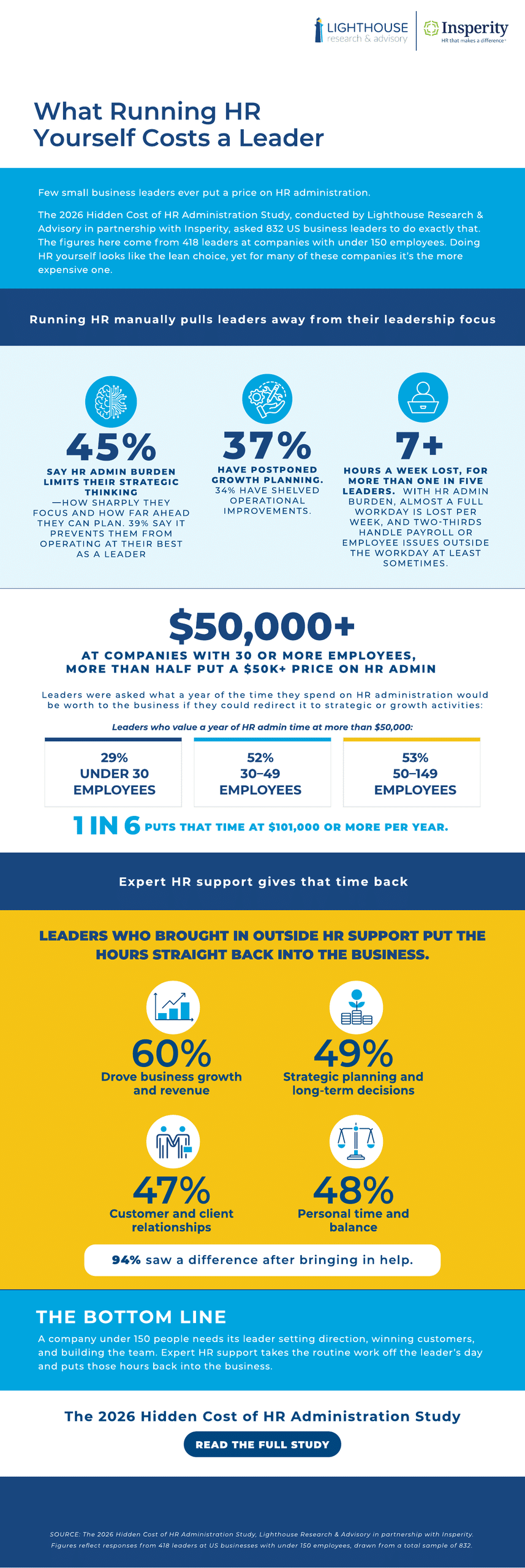
- 45% of leaders say HR administrative responsibilities limit their strategic thinking.
- 39% say HR administration prevents them from operating at their best as a leader.
- 37% have postponed growth or expansion planning because of administrative demands.
- 34% have delayed operational improvements due to HR-related responsibilities.
These findings highlight a difficult reality: when urgent administrative tasks compete with important leadership work, strategic priorities often move to the back burner.

The challenge often intensifies as organizations grow
In the early stages of a business, leaders often manage HR responsibilities because there are few alternatives. Hiring, payroll and employee questions can seem manageable when there are only a handful of employees.
Growth changes the equation.
As organizations add employees, HR administration becomes more complex. Payroll, benefits administration, compliance requirements and employee relations issues all require additional time and expertise.
The research found that among organizations with fewer than 30 employees, only 14% of leaders spend seven or more hours per week on HR administration. At organizations with 30-49 employees, that figure jumps to 26%.
At the same time, concerns increase:
- Regulatory compliance concerns rise from 35% to 50%.
- Concerns about payroll, benefits or compliance errors increase from 37% to 49%.
What worked for a team of 15 employees may not be sustainable for a workforce of 50 or 100.
The research reveals just how significantly HR administration can affect leadership capacity, business performance and personal time. The infographic below highlights some of the study’s key findings.
Administrative work doesn’t stay within business hours
For many leaders, HR tasks extend beyond the workday.
The study found that:
- 64% of leaders handle payroll or employee-related matters outside normal working hours.
- 58% have postponed personal or family activities because of HR administration demands.
On the surface, an hour here and there may not seem significant. Over time, however, those hours add up.
More importantly, after-hours administrative work can leave less capacity for reflection, planning and decision-making. Leadership requires focus and perspective, both of which become harder to maintain when leaders are constantly shifting between strategic priorities and administrative demands.
The opportunity cost of administrative leadership
Every leadership role comes with finite time and energy.
When leaders spend substantial portions of their week on administrative responsibilities, they have less bandwidth for activities such as:
- Strategic planning
- Business growth initiatives
- Customer and client relationships
- Team development
- Process improvement
- Innovation and long-term decision-making
Many leaders recognize this tradeoff. In fact, more than half of leaders at organizations with 30 to 149 employees estimate the value of time reclaimed from HR administration at more than $50,000 annually if redirected toward strategic priorities. Nearly 1 in 6 place that value at more than $100,000 per year.
The finding highlights an important question for growing organizations: Are leaders spending their time on the work that creates the greatest impact?
What leaders do with time they get back
The research also examined what happens when leaders spend less time on HR administration and more time on higher-value business activities.
Among leaders who reported receiving support with HR administration:
- 60% spend more time on growth and revenue-generating activities.
- 49% spend more time on strategic planning.
- 47% spend more time strengthening customer relationships.
- 48% regain personal time and balance.
- 94% report seeing a meaningful difference after receiving support.
The findings reinforce an important point: when leaders can spend less time on administrative responsibilities, they often redirect that capacity toward activities that help drive business performance and long-term growth.
Leadership is too important to be an afterthought
HR administration is a necessary part of running a business. Payroll must be processed. HR compliance requirements must be met. Employee questions must be addressed.
But those responsibilities raise an important question for growing organizations: Who should be spending their time on them?
When leaders are consumed by administrative work, businesses may lose valuable opportunities to focus on strategy, growth and innovation. The research suggests that organizations that proactively address HR administration challenges can help free leaders to concentrate on the work only they can do.
Because leadership capacity is one of an organization’s most valuable resources, and how leaders spend their time ultimately shapes the future of the business.
Key takeaways
- HR administration is more than an operational challenge. It can directly affect leadership effectiveness.
- Nearly half of business leaders say HR administrative responsibilities limit their ability to think strategically.
- As organizations grow, HR administration becomes more complex and time-consuming.
- Many leaders handle HR-related issues outside normal working hours, often at the expense of personal time.
- Businesses that reduce the administrative burden on leaders can create more room for strategic planning, growth initiatives and customer engagement.
- The question isn’t whether HR administration needs to be done. It’s whether leaders are the best people to be doing it.
Frequently asked questions about HR administration and leadership
How does HR administration affect leadership?

HR administration can consume time and attention that leaders would otherwise devote to strategic planning, business growth, team development and customer relationships. According to the research, 45% of leaders say HR administration limits their strategic thinking.
At what point does HR administration become challenging for a growing business?

What HR tasks consume the most leadership time?