

As organizations grow, they often invest heavily in sales, technology and operations to support the next phase of scale. But one critical function can be expected to keep pace without evolving at the same rate: HR.
For many businesses, HR remains rooted in a compliance-first mindset focused on payroll accuracy, policies and risk mitigation. These responsibilities are essential. But when they define the entirety of HR’s role, they can limit its ability to support the business as it becomes more complex.
The greater risk isn’t falling out of HR compliance but rather outgrowing an HR model that was never designed to scale.
Growth doesn’t break HR. Misalignment does. And specifically, when priorities fail to evolve alongside the organization’s evolving complexity, leadership demands and strategic direction.
This blog is grounded in Sapient Insights Group’s report, Strategic HR evolves with business growth, which examines how HR maturity impacts organizational performance across growth stages. The data shows that organizations that evolve HR into a strategic function consistently achieve stronger talent, HR and business outcomes than those operating with compliance‑only models.
Why compliance-only HR becomes a growth constraint
Compliance-focused HR often persists long after the organization has outgrown it. The same approach is applied at every stage of growth, even as business needs fundamentally change.
What works for a 20-person company doesn’t work for a 200-person organization. And what works at 200 can break down at 1,000.
As organizations scale, they often face:
- More complex hiring needs and talent acquisition needs
- Rising expectations around employee experience and development
- Increased demand for leadership capability and succession planning
- More dynamic data driven decision planning
When HR doesn’t evolve alongside these shifts, leaders are forced to make growth decisions without clear insight into workforce impact. Over time, that misalignment can show up as slower hiring, disengagement, leadership gaps and inconsistent performance.
The strategic HR advantage: What the data shows
The Sapient research draws a clear line between organizations that treat HR as a compliance function and those that approach it strategically.
The performance differences are measurable:
- Up to 50% higher talent outcomes
- Up to 47% higher business outcomes
- Significant improvements in HR efficiency and overall organizational effectiveness
These numbers are consistent across industries and company sizes. They appear when HR strategy is aligned with business priorities and the organization’s current growth stage.
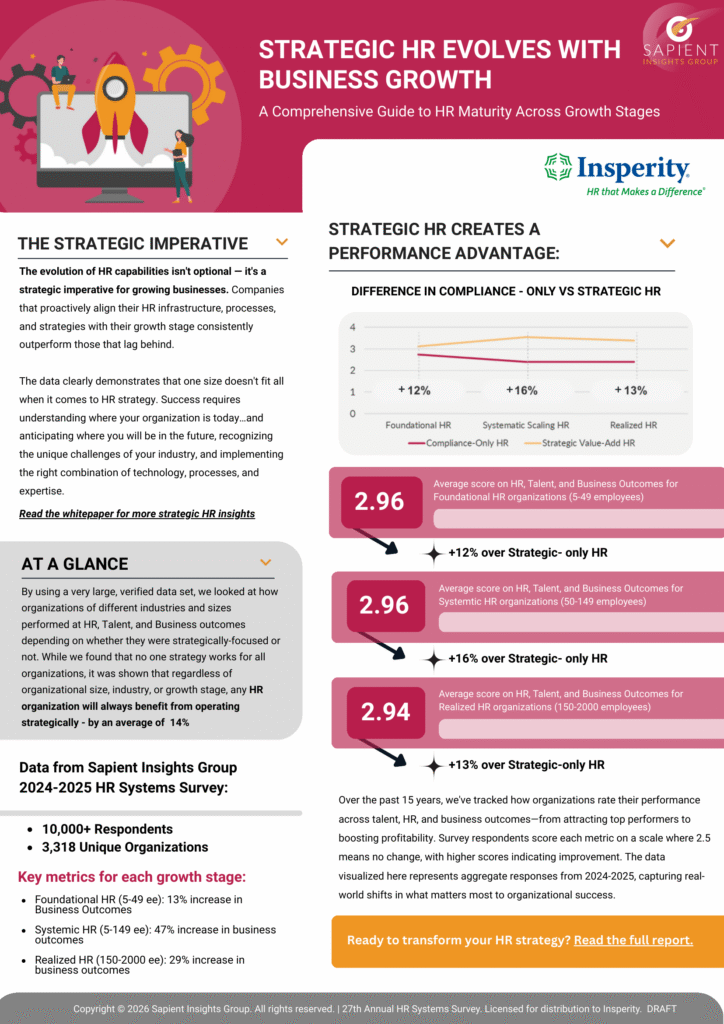
In other words, high-performing organizations don’t just ask HR to support the business, they rely on HR to help shape how the business performs, competes and grows.
Why HR strategy must evolve at every stage of growth
One of the most important findings from the research is that effective HR is not one-size-fits-all. It evolves as the organization grows.
Foundational HR (5–49 employees)
At this stage, the priority is building consistency and structure. When HR is aligned strategically, businesses can establish repeatable hiring and onboarding practices and create early clarity around roles.
Organizations at this stage with strategic HR experience a 13% increase in business outcomes compared to peers operating with compliance-only HR approaches.
Systematic scaling HR (50–149 employees)
As complexity increases, misalignment becomes more costly and strategic alignment becomes more valuable. Organizations at this stage see more consistent leadership development and stronger alignment between people priorities and business goals.
This stage shows the largest lift, with organizations achieving up to a 47% increase in business outcomes.
Realized HR (150–2,000 employees)
At this level, HR shifts from supporting growth to sustaining performance at scale. This can look like focusing on:
- Data-informed talent decisions
- Mature employee experience strategies
- Long-term capability building and succession planning
These organizations prioritizing strategic HR initiatives achieve a 29% improvement in business outcomes compared to less mature HR approaches.
Across every stage, the pattern shows that it’s not the volume of HR activity that drives results but how well that activity aligns with the needs of the business.
What changes when HR becomes strategic
As HR matures, its role in the organization expands beyond execution and administration. Strategic HR functions operate with greater foresight and influence, helping leaders anticipate workforce needs rather than respond to issues after they surface.
Organizations with strategic HR capabilities are better equipped to:
- Anticipate workforce needs before they impact performance
- Align hiring, development and engagement with business priorities
- Use data to guide decisions rather than relying on intuition
- Operate as advisors to leadership, not just administrators
In practice, this means HR is no longer brought in after decisions are made. It helps shape those decisions, ensuring the organization has the people, capabilities and structure required to execute.
A real-world of alignment in action
A 500-person organization like Ridgeline illustrates how operational excellence can create space for strategic impact.
By maintaining high standards in core HR operations with a lean team of three professionals, Ridgeline achieved:
- 99% payroll accuracy
- Improved operational reliability
- Increased employee trust in HR processes
That reliability allowed the HR team to redirect time and attention toward higher-value priorities aligned with business needs. The result wasn’t just efficiency, but greater credibility and influence for HR across the organization.
Moving beyond a one-size-fits-all approach
One of the most common pitfalls growing organizations face is applying the same HR approach at every stage. But the research helps clarify that there is no universal HR model that works across all phases of growth.
Organizations that outperform their peers continually reassess:
- What HR should prioritize next
- Where time and resources should shift
- How people strategy aligns with evolving business goals
For leaders, the goal isn’t to eliminate compliance work, it’s to ensure it doesn’t crowd out strategic impact.
The opportunity for business leaders
For business leaders, the research highlights an important distinction: strong HR outcomes aren’t driven by team size or tool sophistication alone. They also depend on deliberate alignment between HR strategy and business direction.
High-performing organizations are guided by questions such as:
- Is our HR approach designed for where the business is today and where it’s going next?
- Are we investing HR time and energy in activities that directly support growth?
- Do our people practices reinforce the outcomes we’re trying to achieve?
When leaders treat HR as a function that must evolve alongside the business, not just support it, HR becomes a lever for performance, not an operational dependency.
Take the next step
Organizations that intentionally align HR strategy with business growth consistently outperform those that don’t. The full Sapient research explores this connection in depth, including benchmarks, maturity models and practical guidance for evolving HR across every stage of growth.
Download the full report: Strategic HR evolves with business growth. Want more context? Watch the on-demand webinar for deeper insights from HR and business leaders applying these principles today.