

At its core, HR compliance is about protecting your business by minimizing regulatory risks and ensuring adherence to employment laws and regulations. Non-compliance can lead to a wide variety of consequences, including fines, penalties, lawsuits and even the inability to operate, in extreme scenarios.
However, HR compliance is about so much more than legal protection from external authorities like federal, state and local government. It’s also about protecting your workforce and your business, doing the right things inside your organization to achieve success.
Today, it’s a widely discussed that employee experience is a critical driver of strong business performance and long-term success. Less often discussed is how HR compliance actually sets the stage for a positive employee experience. HR compliance is the foundation that supports a great employee experience. Employees who are excited by and committed to their organization then drive performance and results – the pinnacle of what every business is trying to accomplish.
Let’s explore the powerful connection between HR compliance, a positive employee experience and, ultimately, business success.
What business outcomes are associated with HR compliance?
It’s undeniable – HR compliance leads to measurable impacts on businesses.
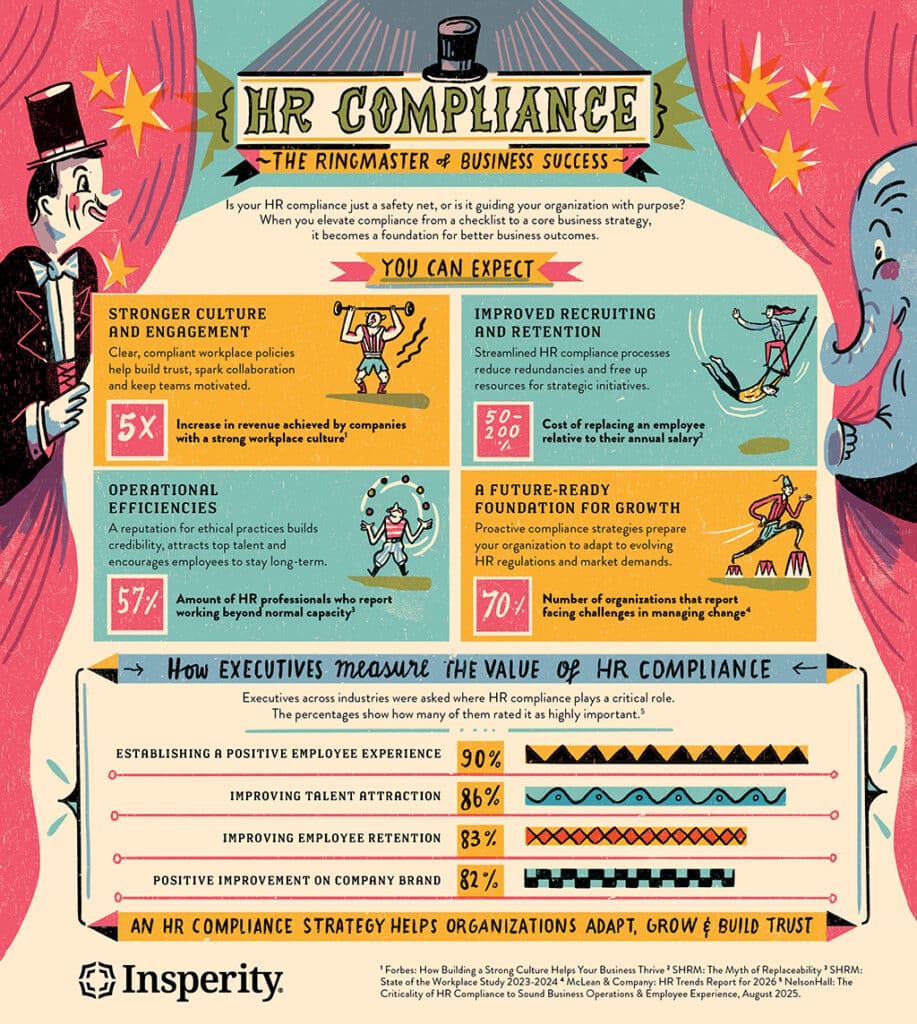
The takeaway is clear: HR compliance does more than protect your business, it helps power performance. The real difference comes down to how strategically you approach it.
Why does strategic HR compliance matter?
Great business results start with a strategic approach to HR compliance.
Strategic HR compliance is so much more than:
- Meeting minimum legal requirements.
- Following rules to avoid getting in trouble.
- Reacting defensively when something negative happens.
Instead, the focus is on:
- Identifying risks that could threaten your organization now or at some point in the future.
- Operating as efficiently as possible.
- Strengthening your organization, putting it in an optimal position to grow and take advantage of new opportunities.
- Creating a stable work environment that establishes clarity and fosters trust, thereby promoting employee engagement, satisfaction, productivity and retention – the basis of a positive workplace culture and employee experience.
- Enhancing the reputation of your brand.
Treat HR compliance as a strategic priority and you support both your people and your company’s success.
How does HR compliance shape the employee experience?
HR compliance touches many aspects of the employee experience and consistently shows up throughout the employee journey, from recruiting and onboarding to separation.
Common examples include:
- A written employee handbook outlining clear, consistent policies: Establishes trust, clarifies expectations, encourages transparency and incorporates consistency and equitable treatment into daily routines.
- Regular communication: Helps employees understand their rights and responsibilities, and keeps them apprised of changes.
- Safety practices: Makes employees feel valued and protected while the company demonstrates care and accountability for their wellbeing.
- Payroll practices and accurate worker classifications: Demonstrates respect for employees, assures them that they are being paid fairly and ensures on-time payment without issues.
- Anti-discrimination and harassment practices: Promotes psychological safety and fairness while preventing charges of favoritism, along with the resulting resentment and conflict.
- Reporting mechanisms for workplace issues: Gives employees a voice and empowers them to speak up, while enabling companies to keep a pulse on what employees think and maintain awareness of issues that could harm compliance.
- Benefits and leave administration: Supports employees during a wide variety of life events and gives them confidence that they will be taken care of.
- Data privacy: Keeps employees’ most sensitive information secure, which protects their privacy, reduces their stress and builds trust in the organization.
- Employee documentation and recordkeeping: Produces a factual record of employee performance and goals – one that can help employees earn recognition and promotions.
- Training requirements: Helps employees feel prepared and empowered to carry out their responsibilities.
- Implementation of technology systems to aid HR compliance: Often makes employees’ daily work easier and more efficient.
When HR compliance “works,” it recedes quietly into the background and everything runs seamlessly, free of errors, hassles or other disruptions. The organization seems like it’s on top of things, which makes employees feel good about working there.
Employees may forget about compliance when all is going smoothly – but it’s a constant factor in creating an environment that prioritizes employee wellbeing, makes their day-to-day life easier and makes employees feel valued and respected.
How can HR compliance undermine the employee experience?
When HR compliance falters, people feel it immediately.And it’s a common issue encountered by businesses. According to a recent report by NelsonHall, nearly half (48%) of companies have experienced potentially costly compliance issues within the past two years, while 88% report a need to enhance their HR compliance in the next 12 months.
Despite recognizing its importance, many organizations still report gaps in their HR compliance capabilities. In fact, fewer than half of companies say they have strong capabilities in several critical areas:
- Employee handbooks and policies: Only 47% of companies report high confidence in their ability to maintain a current, compliant handbook and implement consistent workplace policies, leaving many organizations struggling to keep pace with evolving legal requirements.
- Onboarding and hiring practices: Just 37% report strong capabilities in understanding required onboarding documentation and consistently applying compliant hiring practices, often leading to gaps in paperwork and documentation processes.
- Leave management: Only 39% of companies express high confidence in their understanding of legal requirements for managing leaves of absence, including FMLA and paid leave obligations.
- Training requirements: 39% report strong capabilities in understanding and delivering required HR training, which can lead to missed training, inconsistent processes and lack of proper documentation.
- HR technology systems: Just 37% say they have effective access to and use of technology systems to manage HR operations, data and compliance documentation.
These findings reinforce a broader trend: while HR compliance is widely viewed as critical, many organizations lack the processes, expertise and tools needed to manage it proactively.
Small to mid-size companies typically lack the time or sufficient HR expertise to address compliance proactively. Instead, they struggle to keep pace with changes and frequently take a reactive approach.
Issues can also arise with the execution of HR compliance itself. Examples:
- Compliance is implemented in an opaque way that few understand.
- Policies are enforced inconsistently.
- Compliance is too bureaucratic, rigid and process oriented, overlooking the human element and what works best for employees.
- Employee documentation is mainly used for negative purposes, such as discipline.
- Investigations into issues are slow and dismissive, diminishing the credibility of reporting mechanisms and feedback loops.
All these things degrade the employee experience, their perception of the company and, ultimately, culture, performance and results.
This is because employees feel missteps in HR compliance downstream in the form of confusion, stress and frustration. These breakdowns in HR compliance can destabilize the work environment, disrupt workflow, create personal difficulties and inconveniences for employees and erode their trust and confidence in the organization. Whenever employees are alienated and the issue is not resolved quickly, the usual result is demotivation, disengagement, loss of productivity and higher attrition.
Connecting the dots: Leveraging HR compliance to make employees happy and improve business performance
Here are steps your organization can take right now to enhance HR compliance, the employee experience and business success.
1. View compliance as a tool for managing risks, establishing clarity and building trust.
Managing risks and establishing clarity and trust with employees are deeply interconnected and impactful on business performance. When employees understand risks, why policies exist, how compliance protects them and what is expected of them, that’s when you get buy-in and discretionary effort. When an organization is well positioned and employees are confident, they do their best and business thrives.
2. Embed compliance into everyday operations.
Transform HR compliance from a reactive, policy-driven, “checked a box” function to a proactive, continuous practice: a culture of compliance.
Compliance should be:
- Woven into a company’s values, ethics and culture.
- Considered when making new decisions or implementing new policies or procedures.
- Integrated into all systems and workflows.
- Consistently applied for all employees.
- Part of every interaction between managers and employees, or among peers.
Compliance should feel meaningful and natural, not procedural and administrative.
3. Ensure that compliance supports your business strategy.
What goals do you want your business to achieve in the short and long term? These could be anything from improved safety performance and leadership quality to growth in a certain area.
Make sure your compliance practices align with and support these goals.
4. Use resources that allow for change and improvement.
The legal landscape is in a near-constant state of shift. Partnering with HR resources, such as professional employer organizations (PEOs) with legal expertise, can help to ease the burden of monitoring these legislative changes and figuring out how to adapt. As part of your company’s response to these changes, PEOs can assist with compliance audits, policy development, employee training and change management.
Using HR technology can also help your organization stay on top of compliance and maintain efficiency in workflows. As your organization scales, technology can anticipate and address potential compliance issues associated with growth, leaving no gaps to potentially expose your company to risks and harm the relationship with employees.
Frequently asked questions
Why is strategic, proactive HR compliance important?

Strategic, proactive HR compliance allows organizations to anticipate and address risks before they become costly issues. Rather than reacting to problems as they arise, companies can build structured, scalable processes that support both operational efficiency and long-term growth.
How is thoughtful, well-executed HR compliance linked to the overall employee experience and business success?

In what specific ways can HR compliance enhance or diminish the employee experience?
Key takeaways
- Strategic HR compliance is strongly associated with desirable business outcomes, including establishing a positive employee experience, improved talent attraction and employee retention, and positive impact on the company brand.
- HR compliance touches many aspects of the employee experience, throughout the employee lifecycle. When executed well, this strengthens employee trust, engagement and morale, which enhances productivity and performance to drive better business results.
- On the other hand, missteps in HR compliance can negatively impact the employee experience, which has the opposite effect on employee morale and performance.
- For the best results, adopt a strategic approach to HR compliance. Build compliance into everyday operations and ensure that it supports the business strategy.
For more information about improving HR compliance along with the employee experience and business performance, download The Insperity guide to HR compliance that strengthens your workforce.