


Most business leaders agree on one thing: HR compliance matters.
They understand that employment laws exist to protect employees, reduce risk and create consistency. They know noncompliance can be costly. And many believe their organization is doing “well enough.”
But recent research into small and midsize businesses tells a more complicated story. The criticality of HR compliance report by NelsonHall, in partnership with Insperity, reveals that while confidence in HR compliance is high, actual readiness can fall short. And sometimes those shortcomings are in ways leaders don’t discover until a complaint, audit or lawsuit forces the issue.
The result is a growing gap between intention and execution, especially as companies scale.
Table of contents
What is the confidence gap in HR compliance?
The report states that 84% of small to middle market companies rate HR compliance as highly important. At the same time, nearly half report experiencing a potentially costly compliance issue within the past two years, with average direct costs reaching tens of thousands of dollars.
That’s the confidence gap: the difference between those who see it as important but are still experiencing costly mistakes. This disconnect highlights a central challenge: many compliance risks don’t show up until everyday processes are tested under pressure, like during growth, expansion into new states or complex employee situations.
HR compliance rarely fails all at once. It breaks down quietly, across routine moments that feel manageable until they aren’t.
The new NelsonHall research highlights just how widespread HR compliance gaps are for growing organizations.
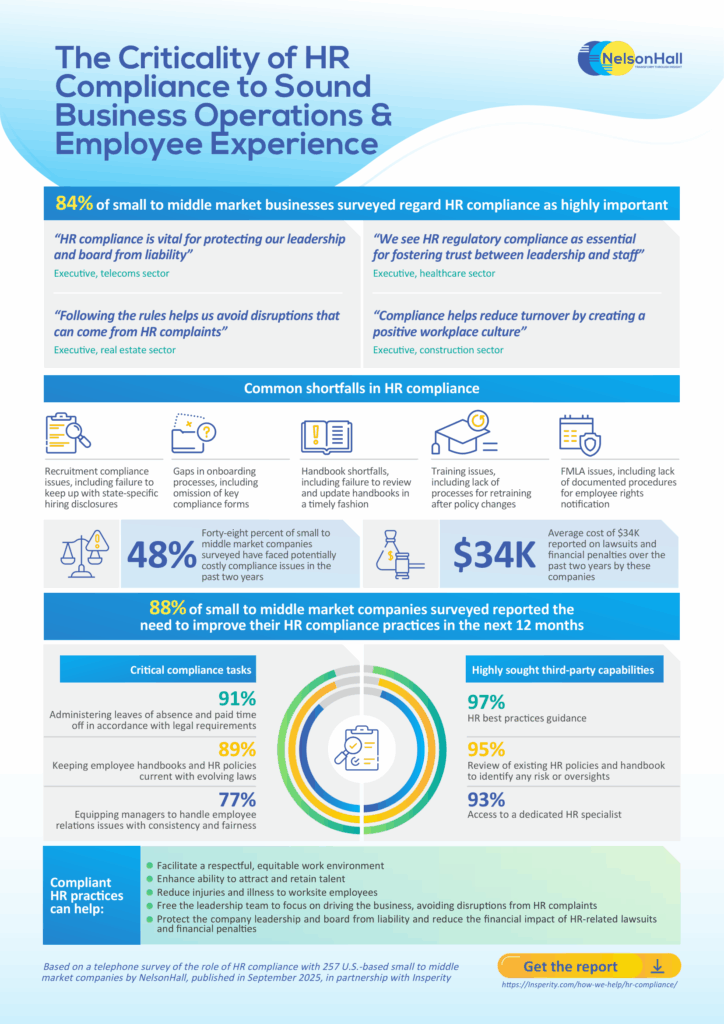
Where HR compliance most often breaks down
Data collected in the report shows that compliance issues tend to cluster around a few recurring areas, especially in growing organizations with limited HR resources.
1. Hiring and onboarding inconsistencies
Recruitment and onboarding are among the most common sources of exposure. Outdated interview guides, missing state-specific disclosures, inconsistent onboarding documentation and incomplete I-9 processes all introduce risk early in the employee lifecycle.
These issues are rarely intentional. They usually stem from processes that haven’t been reviewed as laws evolve or as companies hire across locations.
2. Employee handbooks and policy drift
Many organizations struggle to keep handbooks current, version-controlled and properly acknowledged by employees. Policies may lag behind legal changes or fail to reflect how work is actually done, particularly for remote or multistate teams.
When different versions of a handbook circulate internally, enforcement becomes inconsistent, which can undermine both compliance and employee trust.
3. Training gaps and documentation blind spots
Mandatory training requirements are another frequent pain point. Even when training is delivered, companies may fail to track completion, collect acknowledgments or retrain employees after policy updates.
In the event of a complaint, missing documentation can matter as much as missing training.
4. Manager and supervisor missteps
Managers are often on the front lines of compliance risk, yet many receive limited guidance on how to handle sensitive employee interactions. Inconsistent approaches to performance management, discipline, accommodations or leave requests can quickly escalate into legal exposure.
As organizations grow, the impact of untrained or inconsistently trained managers can become more pronounced.
5. Leave administration complexity
Managing leaves of absence, including FMLA, paid family leave, and paid sick leave, remains one of the most challenging areas of HR compliance. Requirements vary by jurisdiction and company size, and mistakes are common.
These situations are also highly personal for employees, making missteps especially damaging to trust and morale.
Why growth magnifies compliance risk
Many compliance issues emerge not because leaders are careless, but because growth changes the rules.
As companies expand:
- Headcount thresholds trigger new legal obligations
- Geographic expansion introduces overlapping state and local laws
- Informal practices stop scaling
- Managers take on people responsibilities without additional training
Of the companies surveyed in the NelsonHall report, 29% operated in more than one state. Multistate operations can add another layer of complexity, often with policies intended to cover multiple jurisdictions but without the resources to update them as laws change.
What once felt “good enough” can quickly become fragile, and growing companies have to have systematic programs to reduce risk.
The hidden cost of reactive compliance
When HR compliance is reactive rather than proactive, leadership attention shifts away from strategy and toward damage control.
Compliance issues can:
- Disrupt operations through investigations or audits
- Consume leadership and HR bandwidth
- Erode employee trust
- Create reputational risk
- Delay or complicate growth plans
Perhaps most importantly, they introduce uncertainty, both for employees and for leaders making decisions about the future of the business.
Moving from awareness to readiness
Strong HR compliance doesn’t require perfection, but it does require intention.
Organizations that manage compliance effectively tend to:
- Regularly review and update policies and handbooks
- Establish clear processes for training and documentation
- Equip managers with guidance on compliant employee interactions
- Monitor regulatory changes proactively
- Create channels for employees to raise concerns early
Why many organizations seek additional support
Many leaders also recognize that internal teams, particularly lean HR functions, may not have the capacity to manage every aspect of compliance alone.
The NelsonHall report results show that 61% of companies plan to involve third parties to strengthen HR compliance efforts. The goal is not to outsource responsibility, but to gain access to specialized expertise, monitoring and guidance.
For leadership teams, this support can reduce uncertainty, improve consistency and free up time to focus on growth and culture rather than compliance firefighting.
HR compliance as a leadership signal
Ultimately, HR compliance sends a message.
It signals how seriously an organization takes fairness, consistency and accountability. It shapes employee perceptions during moments that matter most. And it also reflects whether leadership is prepared to support growth sustainably.
For CEOs and HR leaders alike, the question is no longer whether HR compliance matters, but whether the organization is truly ready for the complexity it brings. For a deeper look at where small and midsize businesses are most exposed, and how leaders are responding, explore the full research behind today’s HR compliance challenges.