


Employee experience (EX) has become a major conversation in today’s workplace, and for good reason. When people feel supported, equipped and confident in their day-to-day work, they perform better. But for many leaders, one question still lingers:
Is there a real, measurable ROI to employee experience?
The answer is yes, and the returns show up across retention, productivity, customer satisfaction and even long-term culture stability.
In this blog, we’ll cover:
How employee experience delivers measurable business results
A strong employee experience can reduce friction, improve clarity and support people with the tools and leadership they need to excel. These improvements show up quickly in key business metrics:
1. Lower turnover and hiring costs
Employees who feel valued and supported are less likely to leave, reducing the high cost of backfilling roles, training new hires and rebuilding lost knowledge.
2. Higher productivity and engagement
When expectations are clear and workflows make sense, employees spend more time doing meaningful work and less time navigating bottlenecks.
3. Better customer outcomes
Engaged employees provide better service, communicate more clearly and solve problems faster, all of which improve customer loyalty and satisfaction.
4. A stronger employer brand that attracts top talent
Positive internal experiences often translate into external advocacy, helping build a reputation that draws the right applicants.
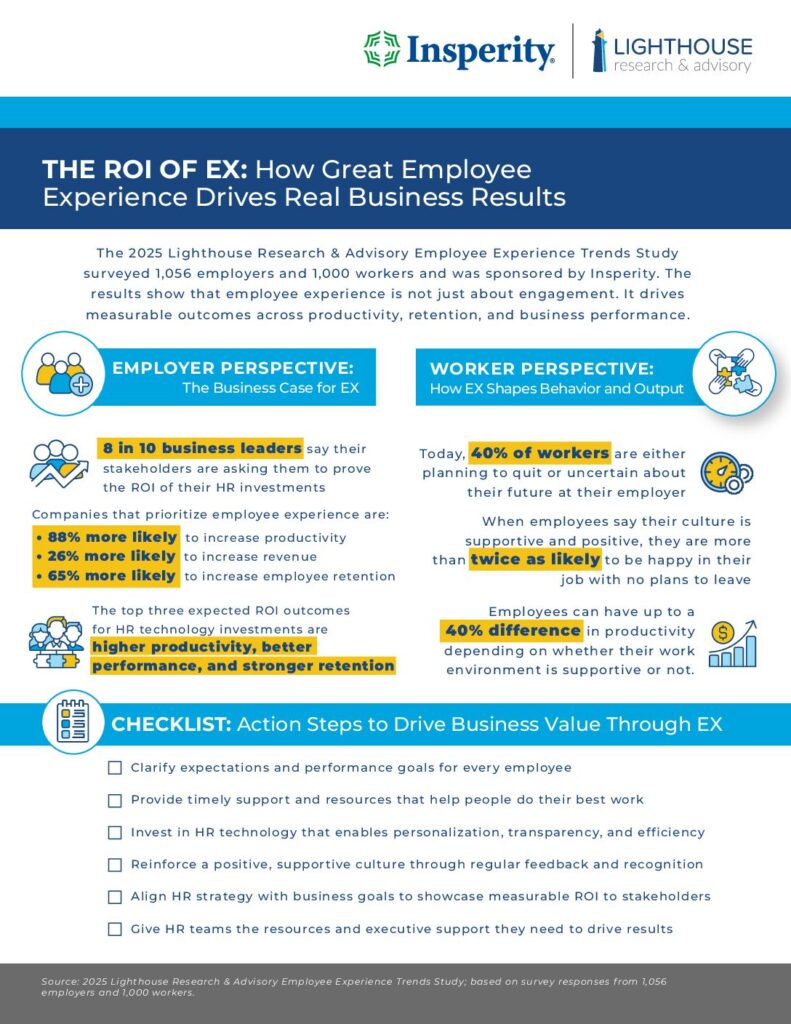
This data shows how improvements in employee experience contribute to measurable business ROI, from retention and productivity to customer satisfaction and long-term growth.
What “ROI of employee experience” really means
Leaders often think of ROI as a straightforward formula: money spent vs. money earned. EX ROI works the same way, but the returns are both financial and operational.
Hard returns (financial impact)
- Reduced turnover and hiring costs
- Higher productivity or output
- Fewer operational errors or defects
- Lower absenteeism
- Improved customer retention and revenue per employee
Soft returns (strategic value that still drives growth)
- Better collaboration and innovation
- Stronger leadership culture
- Higher morale during periods of change
- A more stable employer brand
- Increased internal mobility
How to measure the ROI of employee experience
1. Start with clear goals
Before you dive into numbers, get clear on what matters most for your people and your business right now. Are you trying to reduce turnover? Speed up onboarding? Boost manager effectiveness? Improve customer satisfaction? Or maybe strengthen culture during a big transition? Pick the priorities that will make the biggest impact.
2. Choose metrics that actually show progress
Once you know your goals, decide how you’ll measure success. For example:
- Reduce turnover → Track turnover rate, average tenure, and exit interview themes.
- Improve productivity → Look at output per employee, cycle time, and error rates.
- Strengthen onboarding → Measure ramp time, new-hire satisfaction, and first-year retention.
- Support manager effectiveness → Use engagement scores, team retention, and internal promotion rates.
3. Establish a baseline
Start with where you are today. Pull data from the past quarter or year so you have a clear starting point.
4. Quantify improvements
This is where the ROI comes to life. For example:
- Cutting turnover by just 6% can save tens of thousands of dollars annually.
- Faster onboarding means weeks of productivity gained.
- Better manager training reduces costly errors and miscommunication.
5. Share results and keep refining
Don’t keep the wins to yourself—share them! Quarterly updates work well. Highlight improvements, call out ongoing needs, and show the real impact of your efforts.
Real-world examples of employee experience ROI
Retention improvement
A mid-sized company focused on building a stronger feedback culture and recognition program. The result? Voluntary turnover drops, saving thousands of dollars annually in hiring and training costs,not to mention the value of keeping institutional knowledge intact.
Onboarding efficiency
One organization revamped its onboarding process by introducing digital learning tools and peer mentoring. Ramp time for new hires was cut by two weeks, restoring hundreds of hours of productivity each year and helping employees feel confident faster.
Manager effectiveness
A global team invested in coaching-focused manager training. Within six months, engagement scores rose significantly, and project delays decreased. The ripple effect? Better communication, fewer errors, and stronger team morale, all translating into measurable business outcomes.
Customer experience boost
In a service-driven company, improving employee experience through clearer workflows and better tools led to faster response times and higher customer satisfaction scores. Engaged employees didn’t just work harder, they worked smarter, creating loyal customers and repeat business.
Common challenges when measuring EX ROI
1. Attribution is tricky
Employee experience improvements often overlap with other initiatives, like leadership changes or market shifts, making it hard to pinpoint what drove the results.
2. The payoff takes time
Some benefits, like cultural improvements or engagement boosts, don’t show up overnight. It can take months (or even years) before the full impact is clear.
3. Data lives in silos
HR, finance, and operations often track different metrics in different systems. Pulling it all together for a complete picture can be a real headache.
4. Soft metrics are harder to quantify
Things like morale, trust and sense of belonging matter, but they’re not as easy to measure as turnover or productivity. You’ll need creative ways to connect these to business outcomes.
Key takeaways
Employee experience isn’t just about making work enjoyable, it’s a strategic driver of business success. When employees feel supported and equipped, organizations see measurable improvements across the board.
- EX delivers real ROI through lower turnover, higher productivity, better customer outcomes and a stronger employer brand.
- ROI includes hard and soft returns – from cost savings and efficiency gains to improved collaboration and leadership culture.
- Measuring EX ROI requires a plan – set clear goals, choose meaningful metrics, establish baselines and quantify improvements.
- Challenges exist – like attribution, data silos, and soft metrics, but they can be overcome with the right approach.
If you want a deeper look at the data behind today’s employee experience trends, download the full report, A critical moment: Why employee experience should be every company’s priority.