


HR isn’t just the paperwork police anymore – it’s the secret weapon for driving business success. When done right, HR can improve leadership focus, simplify processes and help manage risk. It plays a direct role in how quickly and effectively your company hits its goals. It’s less “policy patrol,” more “performance powerhouse.”
That’s exactly what Forrester Consulting examined in its Total Economic Impact (TEI) study of the Insperity® HR360 solution1, which delivers end-to-end HR services through a professional employer organization (PEO) model. The study was based on seven Insperity client interviews, analyzing the three-year impact of using Insperity HR360 for midsize businesses. Overall results showed how cost savings, efficiency gains and risk reduction closely align with the broader ways HR can drive measurable ROI.2
What does true growth look like for your business?
Growth is often seen as simply “getting bigger” – adding more employees, customers, products and revenue. But true growth is better defined by a business’s ability to succeed: its likelihood, speed and degree of success.
The Total Economic Impact (TEI) study shows that the Insperity HR360 solution helps businesses achieve this by enabling smarter HR decisions. It supports improved HR compliance and reduced administrative hurdles – so businesses can execute faster and with greater confidence.
This is where HR and ROI align. The study shows that when HR shifts from a reactive, task-based function to a proactive, integrated part of the organization, the impact is measurable.
And to better understand the impact associated with the Insperity HR360 investment, Forrester aggregated the results of the seven organizations studied into a single composite organization, which the data below reflects.
According to the study, the composite organization:
- Reduced the time spent on HR tasks by the equivalent of 1.5 full-time HR employees over a three year period
- Saved $30,000 annually from retiring legacy payroll software
- Cut HR-related non-compliance risk costs by more than $40,000 over three years
Overall, the report states that the operational improvements that resulted from the composite organization implementing Insperity HR360 added up to a 77% return on investment over three years. Those savings didn’t just go straight to the bottom line – they were put to work in leadership time, hiring top talent and improving operations, which accelerated business performance.
From strategic principles to proven results
Check out the infographic below to see the full results and discover what’s possible when HR operates as a true growth engine.
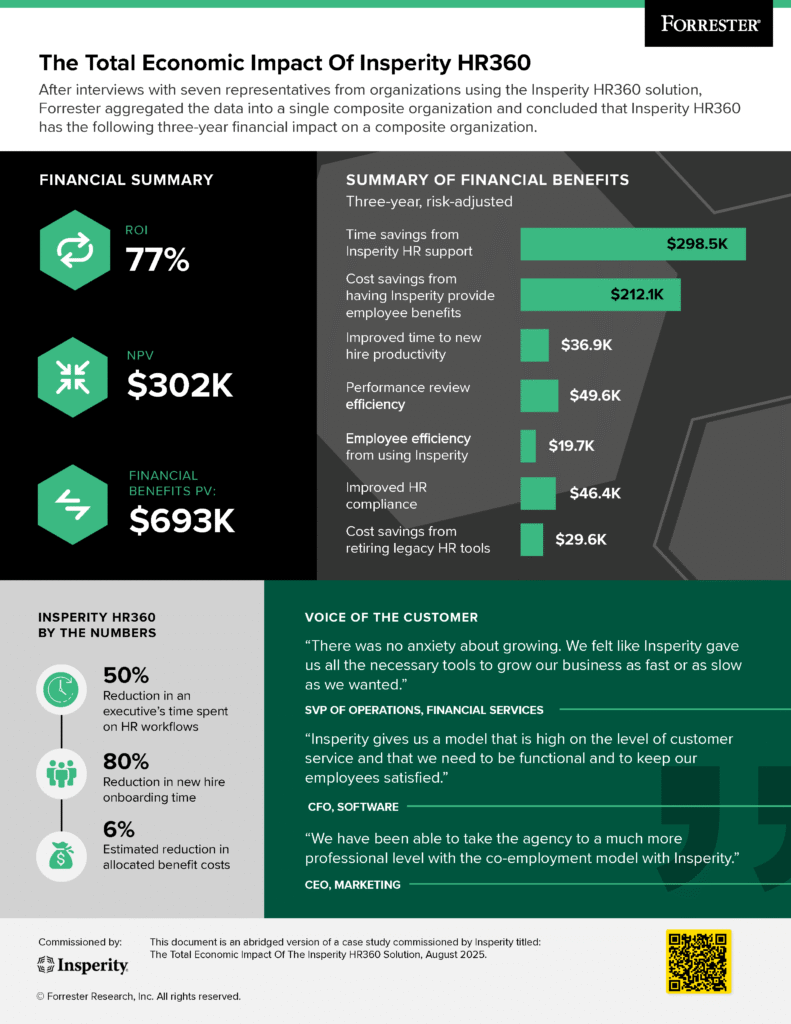
5 ways a PEO creates measurable business value
Understanding HR’s strategic role is one thing, but knowing where it delivers measurable results is another. Here are five key ways strategic HR can drive tangible cost savings, and how Insperity HR360 can help make it happen.
1. Protect leadership bandwidth
Leaders often find themselves bogged down by HR admin tasks, eating up way more time and energy than they’d like. Before you know it, a big chunk of the week is gone, leaving less room to focus on strategy, building client relationships or chasing new opportunities.
According to the TEI study, the composite organization using Insperity HR360 cut an executive’s time dedicated to HR management in half.
This may save leaders over 130 hours annually, which is equivalent to more than three full work weeks they could reinvest into higher-value priorities.
2. Make benefits a talent magnet
In a tight labor market, benefits can be the deciding factor for candidates. With Insperity HR360, Insperity becomes a co-employer and takes over the responsibility for providing employees with benefits. Insperity’s benefit costs are allocated to each client as a component of the client’s comprehensive service fee. The allocated benefit costs are estimated to be 6% lower than what a company may pay for benefits through a broker, and employees still get the same or better coverage.
This shift enhances the ability to attract and retain talent, turning benefits into a powerful recruiting tool and enabling businesses to compete more effectively for top talent across different areas.
3. Turn onboarding into a performance launchpad
A slow onboarding process can be costly for businesses. Every week that a new hire waits for system access, training or benefits enrollment delays their productivity. With remote workforces now the norm, it’s more critical than ever to provide comprehensive onboarding that covers essential areas such as:
- HR and administrative essentials
- Company culture
- Role clarity and expectations
- Technology and tools
- Other big-bucket new-hire must-haves:
- Training and development
- Team integration
- Feedback and support
Onboarding is one of the most critical moments in an employee’s life cycle. Delays at this stage, whether from slow systems access, unclear training steps or disjointed communication, can stall productivity. The TEI study shows that the composite organization using the Insperity HR360 solution has a clear, well-structured onboarding process that reduces onboarding times by 80%.
This efficiency enables new employees to start contributing in days rather than weeks. This efficiency gain can translate into faster revenue contribution, fewer team disruptions and stronger engagement from the start.
4. Remove HR compliance as a roadblock
Expanding into new markets or hiring across state lines can create complex HR-related compliance requirements. The cost of getting it wrong is more than just fines. HR compliance speed bumps can stall projects, erode trust and divert leadership focus. Avoiding these speed bumps without derailing other priorities can be a major challenge.
The study also found that the composite organization using Insperity HR360 reduced HR-related compliance risk by 90%, which translates to an average of $41,000 in avoided non-compliance costs over three years.
Beyond direct financial savings, this level of risk reduction can free leadership to move faster on other growth initiatives and better position the business to stay competitive without sacrificing speed or confidence.
5. Replace tool overload
Having multiple HR systems can slow down decision-making and introduce errors. Multiple logins, inconsistent data and manual reconciliation eat away at productivity, while streamlined technology can improve accuracy and decision-making speed.
The composite organization was able to consolidate HR systems, discontinue legacy tools and save $30,000 annually in software costs while improving data accuracy and reporting speed.
With fewer logins, cleaner data and faster reporting, decision-making becomes quicker and more data driven. Leaders can spot trends, address issues proactively and make informed decisions to pivot strategies when needed.
Forrester’s TEI study puts real numbers to the five measurable areas above, showing that Insperity’s combination of expert HR guidance, compliance support and partnership on enhancing employee experience can free leadership to focus on the important growth-driving initiatives – turning goals into measurable performance gains.
Final takeaway: HR as a measurable performance lever
Strategic HR isn’t just an administrative function, but a true enabler of growth. By saving leadership time, providing access to better benefits, improving onboarding, reducing HR-related compliance risks and streamlining tools, HR can deliver measurable ROI. When businesses invest in HR strategically, the gains compound, leading to faster, more sustainable success. If you want to see the full breakdown of results, executive summary.
The study commissioned was by Insperity and delivered by Forrester Consulting. It is not meant to be used as a competitive analysis.1
The study makes no assumptions as to the potential ROI that other organizations may receive, as results will vary for different organizations.2